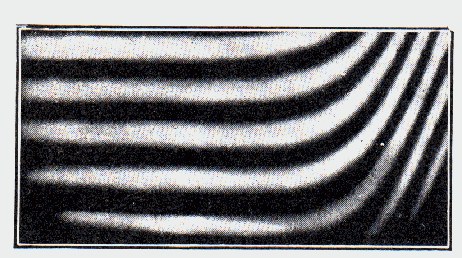
Experimental studies of convection heat transfer coefficients from vertical surfaces took place in the early years of the 20th century, building up a reasonably reliable base of data. Schmidt2 measured in some detail the local upward air velocity and air temperature gradients in front of a 30 cm long heated vertical plate. Figure 1 is an interferometer photograph by Kennard3, illustrating the natural convection air stream approaching a plate 30 °C hotter than room ambient air.
The relatively complex equations and data acquired by these early researchers can be simplified for our low temperature flow range to the following:
- KF
- fin constant
- L
- vertical length of fin (cm)
- Ts
- fin surface temperature (°C)
Further experiments by Payne Engineering in the late 1960s indicated a very high sensitivity of the fin constant KF to any form of blockage which could create turbulent flow disturbances at the heatsink. It was found that these disturbances seriously degraded the cooling ability of the heatsink, and further that additional fins and/or heatsink mass did not alleviate the situation. The most effective fin designs were determined to be those that allowed the highest velocities, approaching the 1 meter/sec of Schmidt’s measurements, over the greatest wetted area.