Popularly known as “heatsinks”, semiconductor heat exchangers are made in a variety of shapes and sizes, both air cooled and liquid cooled. For purposes of this paper, only aluminum air cooled heatsinks will be considered in detail. The future for wide, economical usage of solid state power controls requires a lightweight but compact and reliable design with MTBF (mean time between failures) measured in years. This requirement immediately precludes fan cooling of closely spaced fin heatsink designs, which can fill up and be clogged with dirt and dust in relatively few years.
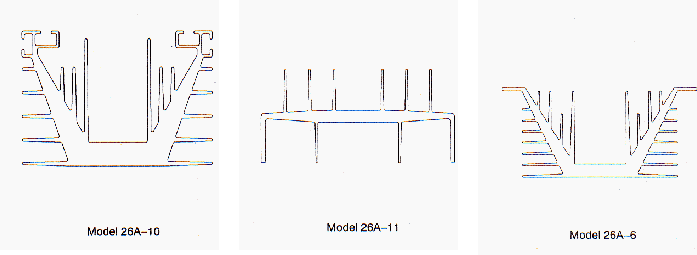
The Model 26A series of aluminum heatsinks has been painstakingly developed since 1961 to provide natural convection and radiation cooling of power semiconductors from 10 amps/phase to 600 amps/phase, using isothermal cross sections with a design goal of 50 °C maximum rise under actual control operating conditions.
| Model | Shape | Amperes | Max °C/watt | Specific weight, lb/ft |
|---|---|---|---|---|
| 26A-1 | 3 in channel | 10–20 | 3.00 | 0.75 |
| 26A-2 | 4 in channel | 30 | 2.00 | 1.05 |
| 26A-8 | 4 in Z-beam | 50–80 | 0.80 | 1.60 |
| 26A-9 | 6 in Z-beam | 150 | 0.45 | 0.40 |
| 26A-11 | 6 in channel beam | 150 | 0.40 | 3.60 |
| 26A-10 | 4 in flat puck | 250–450 | 0.32 | 4.50 |
| 26A-6 | 7.5 in flat puck | 450–1200 | 0.15 | 7.90 |
Extension of the 26A-6 and 26A-10 designs to accommodate the range from 600 amp to 1200 amp, using only standard 4.5 in (110 mm) 100 cfm “muffin” fans, was done to ensure that fan replacements could be easily found anywhere in the world. The wide, natural convection fin spacing has proven to be completely resistant to dirt buildup since their first service in the early 1970s.
For the relatively low temperature vertical surface type heat exchanger above, the heat transferred by convection is substantially larger than that by radiation. The total can be calculated by the following:
- q
- watts
- hc
- convection heat transfer coefficient (watt/cm2 °C)
- hr
- radiation heat transfer coefficient (watt/cm2 °C)
- A
- heat transfer surface area (cm2)